
Middleportal.com – For decades, the path to a stable career followed a predictable script: study hard, earn a high GPA, and collect your diploma as a golden ticket to professional success. However, as we navigate the mid-2020s, that script has been largely rewritten. The job market degree realities of today reflect a world that values what you can actually do over what you studied in a classroom. While a degree still holds value as a foundation, it is no longer the finish line; it is merely the entrance fee to a much more competitive and dynamic arena.
Understanding the Shift in Job Market Degree Realities
Before diving into the specific challenges graduates face, it is essential to understand why the landscape has changed so drastically. Historically, a degree served as a proxy for intelligence and discipline. Employers trusted that a four-year education equipped a candidate with everything they needed.
Today, the rapid pace of technological advancement and the democratization of information have decoupled “learning” from “schooling.” Companies are now more interested in a candidate’s “skill stack”—a combination of technical proficiency, soft skills, and adaptability—rather than just the name of the institution listed at the top of a resume.
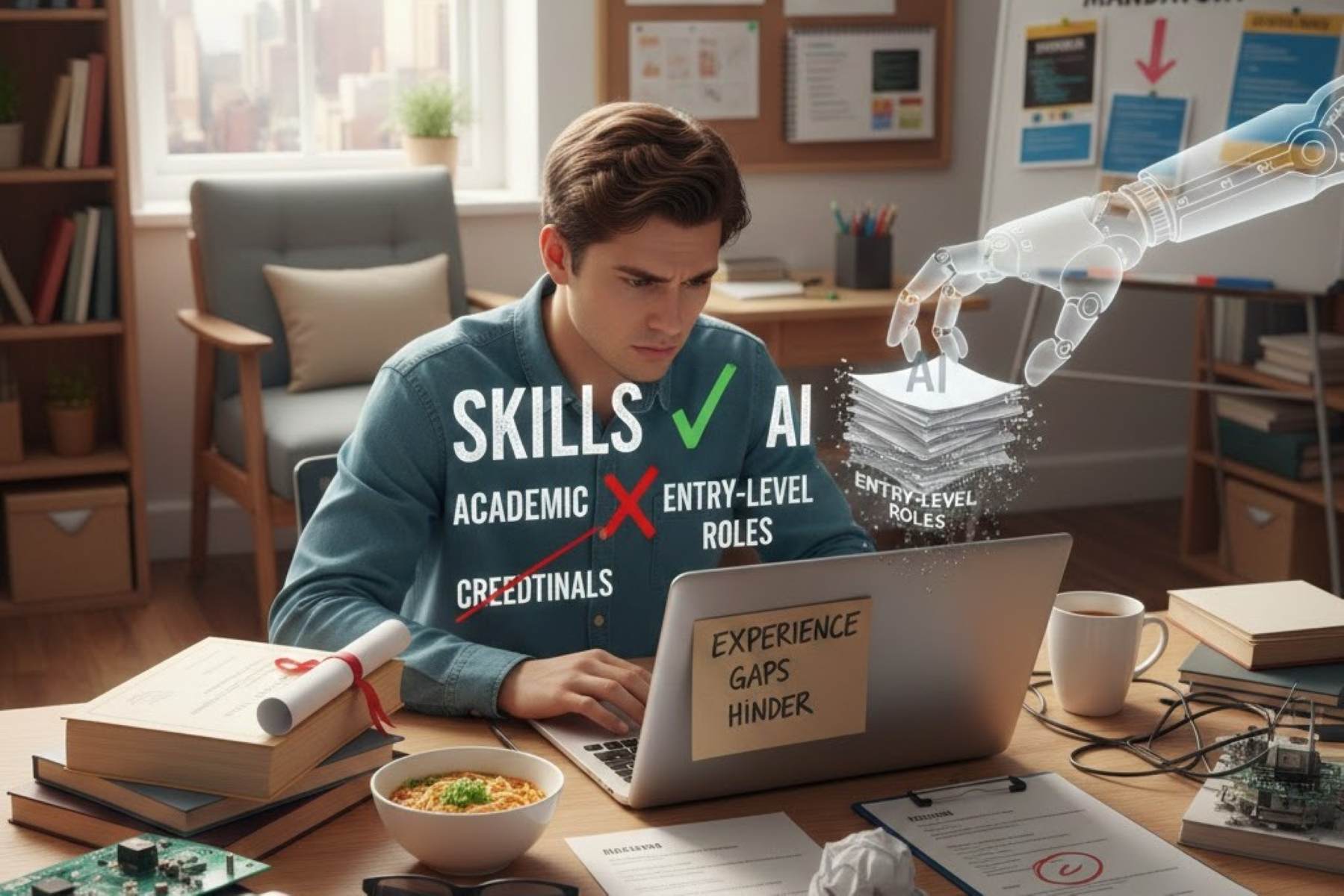
1. Skills Trump Academic Credentials Every Time
The most significant shift in the modern workforce is the transition toward skills-based hiring. Many of the world’s leading tech firms and creative agencies have officially removed degree requirements from their job postings. They have realized that a high GPA in theoretical economics does not necessarily translate to proficiency in data analysis or strategic problem-solving.
In this environment, a candidate who can demonstrate mastery of specific tools or methodologies will often beat out a graduate who only has high marks. Employers are looking for “plug-and-play” talent—individuals who can contribute to projects on day one with minimal hand-holding. This means that your ability to code, write, design, or manage a budget is now your primary currency.
2. The Automation of Entry-Level Roles by AI
Artificial Intelligence has moved past the experimental phase and is now a core component of corporate operations. This has created a “squeezed” job market for new graduates. Traditionally, entry-level roles involved repetitive tasks like data entry, basic drafting, or preliminary research—tasks that served as a “bootcamp” for young professionals.
Now, AI models handle these tasks with incredible efficiency. This means that the “entry-level” bar has been raised. Graduates are now expected to step into roles that require higher-level critical thinking and human oversight immediately. You are no longer competing just with other graduates; you are competing with the efficiency of an algorithm, making it vital to focus on “human-centric” skills that AI cannot easily replicate.
3. The Growing Experience Gap for New Hires
One of the most frustrating job market degree realities is the “experience paradox.” You need a job to get experience, but you need experience to get the job. In 2026, the definition of experience has expanded. Employers no longer consider four years of study as a substitute for professional exposure.
This gap often hinders hiring because companies are increasingly risk-averse. They prefer candidates who have already navigated a professional environment, whether through internships, co-op programs, or long-term freelance projects. If a resume only lists academic achievements without any practical application in a real-world setting, it often finds its way to the bottom of the pile, regardless of how prestigious the university was.
4. Field Mismatch Is a Common Professional Hurdle
It is a common misconception that your degree dictates your career path for life. Statistics now show that a significant majority of professionals work in fields that are entirely unrelated to their undergraduate majors. While this offers a degree of flexibility, it also presents a challenge: many graduates feel underprepared for the specific demands of their actual jobs.
Navigating this mismatch requires a high degree of intellectual humility. You may find yourself starting in a marketing role with a biology degree, or entering project management after studying history. The reality is that your degree provides the “learning how to learn” framework, but the specific industry knowledge must be acquired through curiosity and on-the-job training.
5. Networking Outweighs Transcripts for Opportunities
In a digital-first world, the “hidden job market” has become more influential than ever. A vast majority of high-quality positions are filled through referrals and professional connections before they are even posted on public job boards. While a transcript shows your dedication to your studies, it doesn’t speak to your character or your ability to work in a team.
Building a professional network is no longer an optional “extra” for the ambitious; it is a survival requirement. Who you know—and more importantly, who knows what you are capable of—often matters more than the honors listed on your diploma. Building these bridges through LinkedIn, industry events, and informational interviews is often more productive than sending out a hundred cold applications.
6. Portfolios Beat Paper Qualifications
If a degree is a promise of capability, a portfolio is the proof. Whether you are in a creative field, engineering, or business development, having a tangible body of work is the most effective way to stand out. Employers want to see the “receipts” of your labor.
A well-curated portfolio—containing case studies, code repositories, writing samples, or successful campaign results—provides a narrative that a one-page resume cannot. It allows a hiring manager to visualize you doing the work for their company. In 2026, your digital footprint and the projects you’ve independently brought to life carry far more weight than a piece of parchment.
7. Continuous Upskilling Is Now Mandatory
The final reality of the modern market is that your education has an expiration date. The half-life of many technical skills is now estimated to be less than five years. This means that the day you graduate is actually the day your “second education” begins.
Continuous upskilling through micro-credentials, workshops, and self-directed learning is the only way to remain relevant. The most successful professionals are those who view themselves as “perpetual students.” They stay ahead of industry trends and are always looking for the next tool or methodology to add to their repertoire.
Embracing the New Professional Era
Acknowledging these job market degree realities isn’t meant to be discouraging; rather, it’s meant to empower you. Understanding that a degree is just one part of your professional identity allows you to take control of your career trajectory. By focusing on building a diverse skill set, fostering genuine professional relationships, and maintaining a commitment to lifelong learning, you can navigate this complex market with confidence. The world may no longer prioritize degrees alone, but it deeply values the resourceful, adaptable, and proactive individuals who hold them.